Brandschutz Service Berlin
 und dem


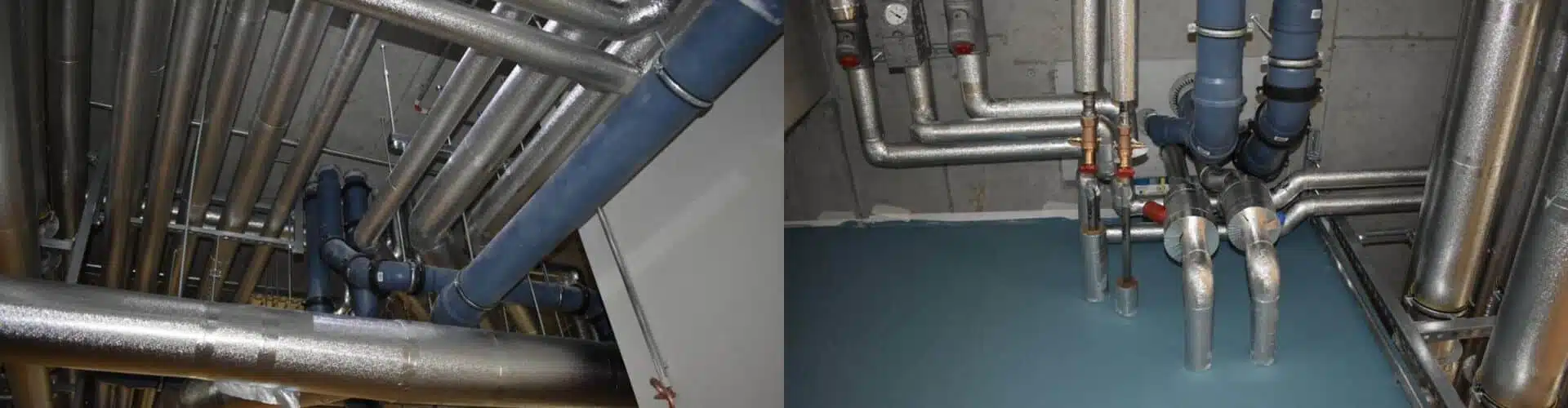
Fire insulation of flammable pipes / lines in fire walls prevents a fire from spreading and offers the lowest possible risk to people in the event of a fire. This measure ensures securing escape and rescue routes as well as the functional integrity of important supply lines.

Sectional insulation is created on pipes that are made of melting or combustible materials. In this case, only a certain length of a pipe is wrapped directly at the component feed-through on both sides by means of non-flammable, insulating half-shells made of mineral fibres. The length of the section insulation is defined and varies depending on the pipe material and dimensions.
This prevents burn-in, dripping, outgassing and the spread of fire through the component. Ventilation ducts can also be converted into ventilation ducts with resistance using pipe half-shells / insulating plates.

Thermal insulation is mandatory in many areas according to the Energy Saving Ordinance (ENEV). Because pipe insulation on air conditioning lines and ventilation ducts, heating lines and hot water pipes, drain pipes or drinking water pipelines not only reduces costs, but also contributes to climate protection.
Furthermore, older buildings in particular have no or only very inadequate thermal insulation. Typically, the insulating effect of the thermal insulation used, e. g. panels or mats, is far greater than that of the masonry, which practically only has a mechanical function.
You must uploadreCAPTCHA the content to submit the form. Please note that this involves sharing data with third parties.
More Information